Today I went along with two birding friends, Don Delaney and Ken Hansen, to the Tomahawk area where Don has friends who own a 9-acre plot of woodland and pasture. The objective: to watch and photograph grosbeaks, Evenings and Pines, and whatever else we might encounter. We did not see any Pine Grosbeaks, but were favoured by a rather large flock (30-50) of Evening Grosbeaks. A sunny and warm January day (+2 C), a bonfire, coffee and Grosbeaks.
Why is this large, sturdy finch with the large, cone-shaped bill called the Evening Grosbeak or Coccothraustes vespertinus, its official Latin name? There is not a good reason, in fact, at least if good reason is based on some prominent aspect of the bird's appearance or behaviour. Some people have suggested that "evening" names the time or, perhaps, evensong quality of its warble. Not so, because the Evening Grosbeak is not a distinguished songbird. It has an extensive repertoire of chirps and calls but not a song, although on rare occasions it does a kind of warble. Nor is it particularly active at vesper time over other parts of the day.
According to Hinterland Who's Who, "in the early 19th century, English-speaking settlers in the foothills of the Rocky Mountains came across a beautiful big-beaked bird that appeared mysteriously from somewhere in the distant west. They named it Evening Grosbeak in the mistaken belief that it came out of the woods to sing only after sundown. French-speakers named this bird more appropriately le gros-bec errant, the wandering grosbeak."
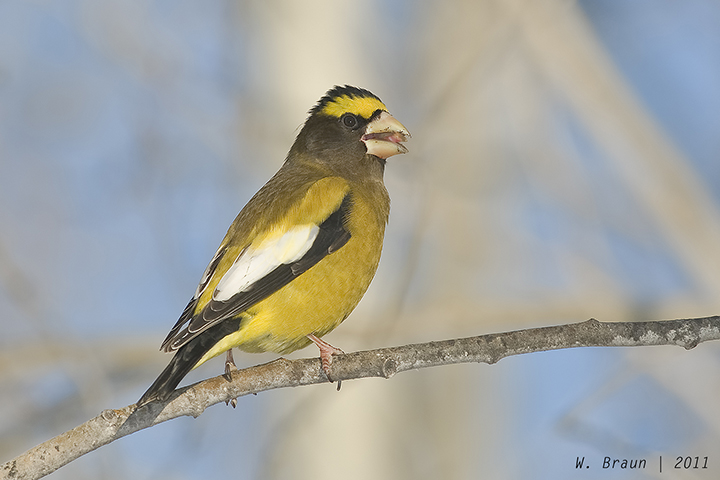
Evening Grosbeaks feed on seeds from the cones of spruce, balsam fir, and pine but they like almost any seed, including sunflower seeds which they can hull with remarkable speed and efficiency.
The two pictures below show the difference between the female and the male in colouration. The female is less brilliantly yellow and more silvery than the male.
Thursday, January 6, 2011
Monday, January 3, 2011
A lucky two hours
An unusually warm and sunny January day (-4 C). I borrowed two hours of afternoon time to be paid back with a very early morning start tomorrow to get my work done before the teaching term starts at the University of Alberta. The two hours were worth it. I went to visit the male Snowy Owl again just north of St. Albert. He was in his usual area along RR261, the so-called "Egg Lake Road," perching on a rural power pole. I'm still waiting to catch him on the ground or on a tree perch or, if I'm lucky, in flight.
While watching Snowy from my truck a flock of Common Redpolls landed on some nearby bushes, then hopped onto the snow-covered range road looking for morsels. I have seen these guys before this winter, but this is the first photo of the season.
On my way back home I could not resist making my usual loop through Hawrelak Park just to see if anything unusual is around. Again, I was lucky. I'd seen several Northern Goshawks in the river valley near the park before, but today one posed long enough to let me snap some shots from a long distance. Goshawks have been reported in numbers much larger than I recall from other years. Nice to add this mature adult to my photo album for 2011.
I was about to pack up my equipment when a pair of Hairy Woodpeckers landed close by and posed in good light. These are not rare in this area, but always entertaining and beautiful birds. Like I said, a lucky two hours.
![]() |
| Male Snowy Owl |
![]() |
| Common Redpolls foraging in snow banks beside a range road |
On my way back home I could not resist making my usual loop through Hawrelak Park just to see if anything unusual is around. Again, I was lucky. I'd seen several Northern Goshawks in the river valley near the park before, but today one posed long enough to let me snap some shots from a long distance. Goshawks have been reported in numbers much larger than I recall from other years. Nice to add this mature adult to my photo album for 2011.
![]() |
| Northern Goshawk |
I was about to pack up my equipment when a pair of Hairy Woodpeckers landed close by and posed in good light. These are not rare in this area, but always entertaining and beautiful birds. Like I said, a lucky two hours.
![]() |
| Male Hairy Woodpecker |
![]() |
| Hairy Woodpecker set for take off |
![]() |
| Female Hairy Woodpecker |
Sunday, January 2, 2011
New Year Light?
A Christmas gift to myself was a Better Beamer flash extender for my Nikon SB900. The Beamer basically captures the flash output, condenses its focus to as to extend the distance of the flash beam. It is designed to be used with telephoto lenses and a distant image object that would not be "flashed" without extending the flash beam.
Today the conditions were just about right for testing the Better Beamer. Heavily overcast, gray day, with some snow flakes, flat and low light. Fill flash will lustre up the birds, I thought. I took my 300mm f2.8, snapped in a 1.4x teleconverter, dialed in ISO 400, set the camera to aperture control mode, adjusted my flash to -0.7 compensation (to make sure I used enough of the ambient light with some assist from the flash) and went to Hawrelak Park were I can count on seeing several woodpeckers, nuthatches and chickadees -- the usual suspects, in other words. Here are a few results. Not bad for a first attempt at fill flashing with the Better Beamer.
![]() |
| Male Downy Woodpecker |
![]() |
| Male Hairy Woodpecker |
Friday, December 31, 2010
Last pictures of 2010
We braved the cold (-20) and drove to Elk Island National Park, looking for bison to show our BC visitors. I was just as happy to find a few resident winter birds, including a Ruffed Grouse.
![]() |
| Ruffed Grouse |
![]() |
| Downy Woodpecker (with an unusual cowlick on her side) |
![]() |
| Hairy Woodpecker |
![]() |
| White-breasted Nuthatch |
![]() |
| White-breasted Nuthatch |
![]() |
| White-breasted Nuthatch |
Wednesday, December 29, 2010
Winter company
Our regular backyard and urban park birds are fewer in species and number than in spring and summer. Among our regulars at the feeders are Black-capped Chickadees, the occasional Boreal Chickadee, White- and Redbreasted Nuthatches, Downy and Hairy Woodpeckers, Blue Jays, and Black-billed Magpies. We get irregular visitors too now and then, but more about them as they show up ...
![]() |
| Black-capped Chickadee |
![]() |
| Boreal Chickadee |
![]() | ||
| Downy Woodpecker |
![]() |
| Hairy Woodpecker (banded) |
![]() |
| Magpie |
![]() |
| Blue Jay |
![]() |
| White-breasted Nuthatch |
![]() |
| White-breasted Nuthatch |
![]() |
| Red-breasted Nuthatch |
Saturday, December 25, 2010
Christmas Day Waxwings
One of the pleasures of the long and harsh winter is the regular visit of large flocks of Bohemian Waxwings. They fly in amoeba-like undulating formation, then swoop down and blanket a tall poplar or spruce tree in the neighbourhood. From there they spot the numerous Mountain Ash trees and other berry and crab-apple trees. They swoop down on them, feverishly feed, then move on. Last winter, these birds hardly visited, probably because after a dry summer the berry supply was better elsewhere. Nice to have them back.
A year of birding 2011
I will try to document a year of birding in the blog format. Start date is Christmas 2010.
On Christmas Eve day we spent about 5 hours along the range and township roads north of Edmonton. We looked for Snowy Owls in the Egg Lake area northwest of Morinville. This is where they can be reliably seen most winters. From other birding friends in Edmonton I had heard reports of Snowies, so thought we would check it out for ourselves. We did spot a male, perched on a pole, then later in a grain field at a distance too far for photographing.
We continued further north to the Opal area and the nature reserves around Opal and to the north (between township roads 584 and 592 west of Hwy 2 and east as far as RR 225), looking for Northern Hawk Owls and Great Grays. No luck on the owls, but we saw our first flocks of Common Redpolls and Snow Buntings of the winter.
On the way home we stopped at Hawrelak Park hoping the Pine Grosbeaks would be around. They like to come to this park and feed on several ornamental crab apple trees. Sure enough, our timing was perfect.
On Christmas Eve day we spent about 5 hours along the range and township roads north of Edmonton. We looked for Snowy Owls in the Egg Lake area northwest of Morinville. This is where they can be reliably seen most winters. From other birding friends in Edmonton I had heard reports of Snowies, so thought we would check it out for ourselves. We did spot a male, perched on a pole, then later in a grain field at a distance too far for photographing.
We continued further north to the Opal area and the nature reserves around Opal and to the north (between township roads 584 and 592 west of Hwy 2 and east as far as RR 225), looking for Northern Hawk Owls and Great Grays. No luck on the owls, but we saw our first flocks of Common Redpolls and Snow Buntings of the winter.
On the way home we stopped at Hawrelak Park hoping the Pine Grosbeaks would be around. They like to come to this park and feed on several ornamental crab apple trees. Sure enough, our timing was perfect.
Subscribe to:
Posts (Atom)


