Wednesday, January 19, 2011

Redpolls

Yesterday a single female Common Redpoll was busily flitting about among the Chickadees at the Hawrelak Park bird feeders. I have seen them in flocks of 10-50 this winter, usually high up on birch stands, foraging on the birch seeds. They come to my own feeders occasionally.

 Female Common Redpoll - Acanthis flammea

This little finch breeds in the open subarctic areas of largely coniferous forest and scrub; it nests  on tundra and above timberline where shrubby deciduous and sometimes coniferous vegetation occurs in hollows and sheltered places. It feeds on small seeds and other plant material throughout the year. In the winter it wanders southward in search of food. It is one of our most delightful winter finches.

Saturday, January 15, 2011

A lone Downy

The largest January snowfall in decades and now days of very cold temperatures (-25 to -30 C). I went out the river valley woods for a bit today to how the winter birds are coping. Saw all of the usual: chickadees, nuthatches, magpies, a raven, and heard a group of Redpolls fly overhead. I came across this Downy Woodpecker, sitting unusually still. I thought he might be hypothermic, but after 10 minutes he resumed foraging. Perhaps he was just having a nap.
Red Squirrel

Black-capped Chickadee
Male Downy Woodpecker 

Thursday, January 13, 2011

Creeping around

The Brown Creeper (Certhia americana) is the only North American species of the Creeper family. It gets its name from its distinctive behaviour. It creep up tree trunks, starting at the base of a tree, then  spiraling upward around the trunk until it nears the top.Then it repeats its upward spiral creep either on the same tree or a different one. Not a vegetarian by preference, it forages for a variety of insects and larvae, spiders and their eggs, and ants in the tree bark. It prefers mature, unlogged coniferous forests and mixed coniferous-deciduous forests. I have only seen it on trunks of large trees.

It is difficult to spot this small, well-disguised bird, but recently it has appeared now and then in my backyard. Last seen yesterday, January 12, 2011.

Brown Creeper (Certhia americana)

Monday, January 10, 2011

Blizzard and birds

On Friday, January 7 to Sunday, January 9 we had the single largest snow storm since 1989. About 40cm of snow, blown into meter high drifts by high winds. Most birds hunker down and wait it out. Bohemian Waxwings seem to love this weather. While shovelling snow on Sunday a flock of an estimated 2000 frolicked through the neighbourhood, descending like a cloud on mountain ash trees and other berry trees.


Thursday, January 6, 2011

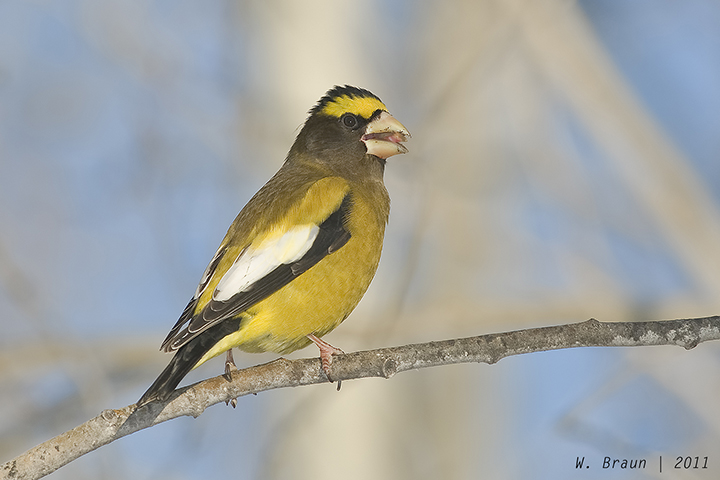
Evening or Wandering Grosbeaks?

Today I went along with two birding friends, Don Delaney and Ken Hansen, to the Tomahawk area where Don has friends who own a 9-acre plot of woodland and pasture. The objective: to watch and photograph grosbeaks, Evenings and Pines, and whatever else we might encounter. We did not see any Pine Grosbeaks, but were favoured by a rather large flock (30-50) of Evening Grosbeaks. A sunny and warm January day (+2 C), a bonfire, coffee and Grosbeaks.


Why is this large, sturdy finch with the large, cone-shaped bill called the Evening Grosbeak or Coccothraustes vespertinus, its official Latin name?  There is not a good reason, in fact, at least if good reason is based on some prominent aspect of the bird's appearance or behaviour. Some people have suggested that "evening" names the time or, perhaps, evensong quality of its warble. Not so, because the Evening Grosbeak is not a distinguished songbird. It has an extensive repertoire of chirps and calls but not a song, although on rare occasions it does a kind of warble. Nor is it particularly active at vesper time over other parts of the day.


According to Hinterland Who's Who, "in the early 19th century, English-speaking settlers in the foothills of the Rocky Mountains came across a beautiful big-beaked bird that appeared mysteriously from somewhere in the distant west. They named it Evening Grosbeak in the mistaken belief that it came out of the woods to sing only after sundown. French-speakers named this bird more appropriately le gros-bec errant, the wandering grosbeak."


Evening Grosbeaks feed on seeds from the cones of spruce, balsam fir, and pine but they like almost any seed, including sunflower seeds which they can hull with remarkable speed and efficiency.

The two pictures below show the difference between the female and the male in colouration. The female is less brilliantly yellow and more silvery than the male.


Monday, January 3, 2011

A lucky two hours

An unusually warm and sunny January day (-4 C). I borrowed two hours of afternoon time to be paid back with a very early morning start tomorrow to get my work done before the teaching term starts at the University of Alberta. The two hours were worth it.  I went to visit the male Snowy Owl again just north of St. Albert. He was in his usual area along RR261, the so-called "Egg Lake Road," perching on a rural power pole. I'm still waiting to catch him on the ground or on a tree perch or, if I'm lucky, in flight.

Male Snowy Owl
While watching Snowy from my truck a flock of Common Redpolls landed on some nearby bushes, then hopped onto the snow-covered range road looking for morsels. I have seen these guys before this winter, but this is the first photo of the season.

Common Redpolls foraging in snow banks beside a range road


On my way back home I could not resist making my usual loop through Hawrelak Park just to see if anything unusual is around. Again, I was lucky. I'd seen several Northern Goshawks in the river valley near the park before, but today one posed long enough to let me snap some shots from a long distance. Goshawks have been reported in numbers much larger than I recall from other years. Nice to add this mature adult to my photo album for 2011.

Northern Goshawk

I was about to pack up my equipment when a pair of Hairy Woodpeckers landed close by and posed in good light. These are not rare in this area, but always entertaining and beautiful birds. Like I said, a lucky two hours.

Male Hairy Woodpecker
Hairy Woodpecker set for take off

Female Hairy Woodpecker

Sunday, January 2, 2011

New Year Light?

A Christmas gift to myself was a Better Beamer flash extender for my Nikon SB900. The Beamer basically captures the flash output, condenses its focus to as to extend the distance of the flash beam. It is designed to be used with telephoto lenses and a distant image object that would not be "flashed" without extending the flash beam.

Today the conditions were just about right for testing the Better Beamer. Heavily overcast, gray day, with some snow flakes, flat and low light. Fill flash will lustre up the birds, I thought.  I took my 300mm f2.8, snapped in a 1.4x teleconverter, dialed in ISO 400, set the camera to aperture control mode, adjusted my flash to -0.7 compensation (to make sure I used enough of the ambient light with some assist from the flash) and went to Hawrelak Park were I can count on seeing several woodpeckers, nuthatches and chickadees -- the usual suspects, in other words. Here are a few results. Not bad for a first attempt at fill flashing with the Better Beamer.

Male Downy Woodpecker
Male Hairy Woodpecker