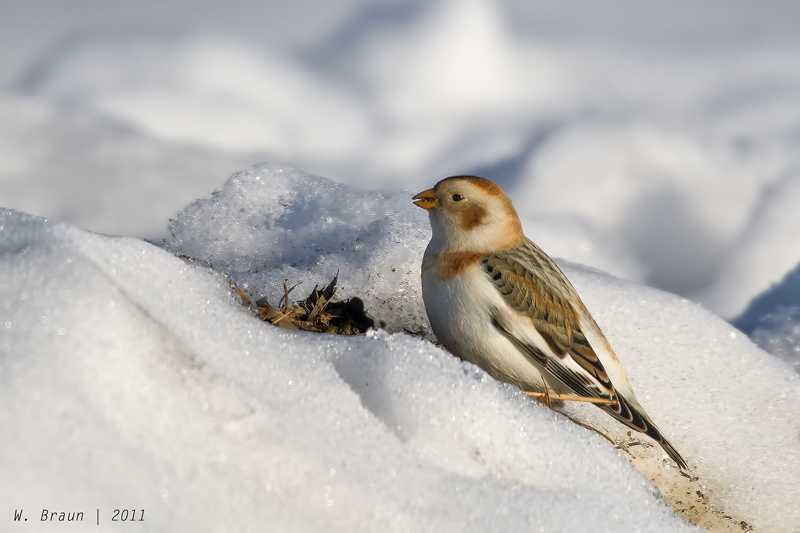
Snow Buntings (Plectrophenax nivalis) are one of the two most northerly-breeding passerines in North America. (The other being the Hoary Redpoll.) They breed on arctic and far northern alpine tundra. In Alberta we see them only as migrants and winter residents, often in flocks numbering anywhere from a few dozen birds to a few hundred. Typical locations are roadsides, stubble fields and shortgrass prairie.
Though commonly seen (any trip along the farm roads east and north of Edmonton is bound to scare up flocks of them) they are shy and difficult to approach for photography.
A long lens helps. Sometimes the car can serve as a hide. For these pictures I set up my truck as a blind, put up my 500mm lens on a tripod, pulled a chair from the truck and sat down to wait for where I had first seen them and scared them away. An oilfield installation near a railway track. The oilfield facility is regularly plowed to allow service vehicles to approach. The windrows contain clumps of dirt and straw that attract these birds.A thermos full of coffee, a book, and a sunny +5C temperature made the wait comfortable. I knew they would return. They did. Clearly they knew I was there but eventually they came close enough for a reasonably decent set of pictures. These are from a flock of about 200.
Sunday, February 13, 2011
Larks announce spring
Yesterday we went to Elk Island National Park along the backroads north of Highway 16. We'd hoped to have a look at the Northern Hawk Owl that has set up hunting territory near Ft. Saskatchewan. We saw the owl.
More exciting, though, was coming across a pair of Horned Larks (Eremophila alpestris). These are Alberta's earliest spring migrants, arriving in February, finding food on wind-swept farm fields or on the bare plowed edge range roads and township roads. Once the Horned Larks arrive I allow myself to get just a touch of spring fever.
Thursday, February 10, 2011
Redpolls: Hoary and Common
Hoary Redpolls and Common Redpolls are among my favourite winter finches. The Hoary's breeding and summer region is the high arctic. They and are not known to breed anywhere in Alberta, but do come down from the far north in winter in small numbers. The Hoary's most southerly breeding area is in the Churchill region of northern Manitoba. The Common Redpoll wanders down in the winter in much greater numbers. It too breeds in the arctic regions, though their range includes extreme north-eastern Alberta.
On their breeding grounds Hoary Redpolls, like Common Redpolls, hang out in patches of scrubby birch and willow. In winter, Hoary Redpolls are occasionally seen with flocks of Common Redpolls and I always scan flocks to look for the scarcer Hoary. The two Redpolls look very similar to each other. The Hoary Redpoll is paler overall, whiter on the chest and displaying little or no streaking on flanks. Hoarys appear bulkier, probably due to greater feather mass and fluffier plumage. Their bill is shorter and stubbier and surrounded by denser feathering at base so that it appears even smaller.
This winter the Hoarys have been reported more frequently than in recent past winters. I was lucky to have one pose for me yesterday just for a second. Below is the Hoary and the Common, both females. You can see the difference when they are side by side.
![]() |
| Hoary Redpoll (Acanthis hornemanni) |
![]() |
| Common Redpoll (Acanthis flammea) |
Wednesday, February 9, 2011
Partridges in a stubble field
Today I had a few hours to ride the range roads east of Edmonton. The sun was out, the recent cold snap receded. A lovely day for partridges, though they were not an intentional target bird. I was lucky enough to run into several coveys ranging from a group to six to one that numbered about 20.
The Gray Partridge (Perdix perdix) is a grayish-brownish partridge, a bit larger than a quail. It has a rusty face and chestnut bars on the sides. Both sexes are nearly identical, but the adult male has a distinct horseshoe-shaped, chestnut patch on its breast. When flushed, it displays a short rufous tail.
A native of the bush plains of Europe and western Asia, the species was introduced to central and southern Alberta in 1908 for hunting purposes. Perhaps it came from Hungary; its alternate name is Hungarian Partridge, often abbreviated to Hun – as in a covey of huns. It is now well-established in the prairies and parklands of Alberta.
The gray partridge is well-suited to prairie winters, using windbreaks and straw piles for shelter, and foraging on stubble fields of grain especially during the winter months. They feed also insects during the summer months, as well as green leaves, shoots, and buds.
Monday, January 24, 2011
Goshawks and Mallards
On Edmonton's eastern outskirts on the south bank of the North Saskatchewan River, the Gold Bar Wastewater Treatment Plant handles the waste water requirements for the greater Edmonton area. In one year, the treatment volume at the plant is roughly 100,000 million litres - enough to fill 37,000 Olympic-length swimming pools (more than 100 per day). All this warm treated water flows in the river and keeps a sizable stretch of it from freezing. During the winter this stretch of water is home to 1000s of Mallards, a few Common Goldeneyes and, occasionally, some other waterbirds. This contained smorgasboard of course attracts predators. Several Bald Eagles and Northern Goshawks have taken up winter residence here and regularly dine on ducks.
The Northern Goshawk (Accipiter gentilis) is the largest and heaviest of the three North American accipiters. Goshawks are larger than Sharp-shinned Hawks (Accipiter striatus). Male Northern Goshawks can be of similar size to female Cooper's Hawks (Accipiter cooperi), but Northern Goshawks have broader wings and a relatively short tail compared to Cooper's Hawks. The Northern Goshawk has a long tail with a broad, dark sub-terminal band and three to four narrower dark bands, rounded wing tips, and a conspicuous pale eyebrow. The sexes are similar with adults having a dark crown, blue-gray back, white underparts with fine, dense gray barring and conspicuous white undertail coverts. The eyes of adults are deep ruby-red and the feet are yellow. Immature Northern Goshawks are brown above, buffy below, with dense, blurry streaking.
This aggressive predator is built to move quickly and quietly. It approaches its prey stealthily, moving unnoticed through dense cover, until it is close enough to overcome its prey in mid-air with a burst of speed, or drop out of a tree and swoop down on ground-dwelling prey. The are opportunistic feeders, eating a wide variety of prey. Squirrels, snowshoe hares, grouse and medium to large songbirds are all potential prey of the goshawk. In Goldbar, Mallards are the overwhelming protein of opportunity.
The Northern Goshawk (Accipiter gentilis) is the largest and heaviest of the three North American accipiters. Goshawks are larger than Sharp-shinned Hawks (Accipiter striatus). Male Northern Goshawks can be of similar size to female Cooper's Hawks (Accipiter cooperi), but Northern Goshawks have broader wings and a relatively short tail compared to Cooper's Hawks. The Northern Goshawk has a long tail with a broad, dark sub-terminal band and three to four narrower dark bands, rounded wing tips, and a conspicuous pale eyebrow. The sexes are similar with adults having a dark crown, blue-gray back, white underparts with fine, dense gray barring and conspicuous white undertail coverts. The eyes of adults are deep ruby-red and the feet are yellow. Immature Northern Goshawks are brown above, buffy below, with dense, blurry streaking.
![]() |
| Juvenile Goshawk |
![]() |
| Soaring in the updraft of the North Saskatchewan River bank |
Saturday, January 22, 2011
Great Gray Owl
Great Gray Owls (Strix nebulosa) are the largest owl species in North America. They have a wingspan over 4 feet with a body length of up to 27 inches. They can weigh over 2 pounds. Females are usually larger than males, but they are otherwise identical in appearance. Great Gray Owls have a large, rounded, half-domed head with a large, flat facial disk and no ear tufts. The Great Gray Owl was first described by Johann Reinhold Forster in 1772. The name "nebulosa" is derived from the Latin nebulosus, "misty, foggy." Perhaps for this it has also been called Great Gray Ghost or Phantom of the North. It's the provincial bird of Manitoba.
Friday, January 21, 2011
Lord of the Woodies
The large and spectacular Pileated Woodpecker (Dryocopus pileatus) is the second-largest woodpecker in North America, second only to the Imperial Woodpecker (C. imperialis) of montane western Mexico. (I am not counting the probably extinct Ivory-billed Woodpecker (Campephilus principalis) of the southeastern United States.) When it flies in with its 70-75cm wingspan it is a startling sight indeed. It is common, though not numerous, in the forested corridors of the central Canadian prairies (among many other regions of Canada and the US) and a regular sight in the city of Edmonton, including the campus of the University of Alberta, where I work.
Yesterday this spectacular male (distinguished by the red bar under his chin) came swooping into the Arts quad and starting working on a pine tree. I had to rush to get my camera from my office. When I returned he came towards me and landed on a tree so close by that I had too much lens to get the entire bird into the picture.
![]() |
| Male Pileated Woodpecker (Dryocopus pileatus) |
Subscribe to:
Posts (Atom)