Saturday, March 12, 2011

Great Gray day

Wednesday, March 9, sunny , started out -18C in the morning but warmed -2C by about noon.  My aim was to comb the range and township roads (snow-covered dirt roads), looking for Great Gray Owls (and Hawk Owls, of which none were found) in the wooded areas of the Halfmoon Lake Natural Area and Opal Natural Area, roughly bounded by TWP 570 in the south, TWP 592 in the north, RR 221 in the east and RR 235 in the west. It’s prime Great Gray country. And on this day it actually was!


In Alberta, the Great Gray inhabits forests of the boreal regions and foothill regions in the central and northern parts of the province, but their total range includes the circumpolar coniferous forests of the world. The Great Gray owl is a naturally scarce species. This along with its need for declining mature forests during the nesting period has earned the classification as Sensitive in the current General Status of Alberta Wild Species report.


Since they hunt from a perch, either tree a raised dead snag or a fence post, they are often easy to spot from a distance as a large feathery blob outlined against the sky.


Although the Great Gray is the tallest owl in North America, measuring about 75cm long, most of its apparent bulk comes from its fluffy plumage and large head. Its body weight, at about 2.5 pounds, is less than that of the Great Horned Owl and the Snowy Owl.  From its perch this Great Gray listens for prey. Though their vision is good, hearing is an even more valuable tool for these forest hunters.
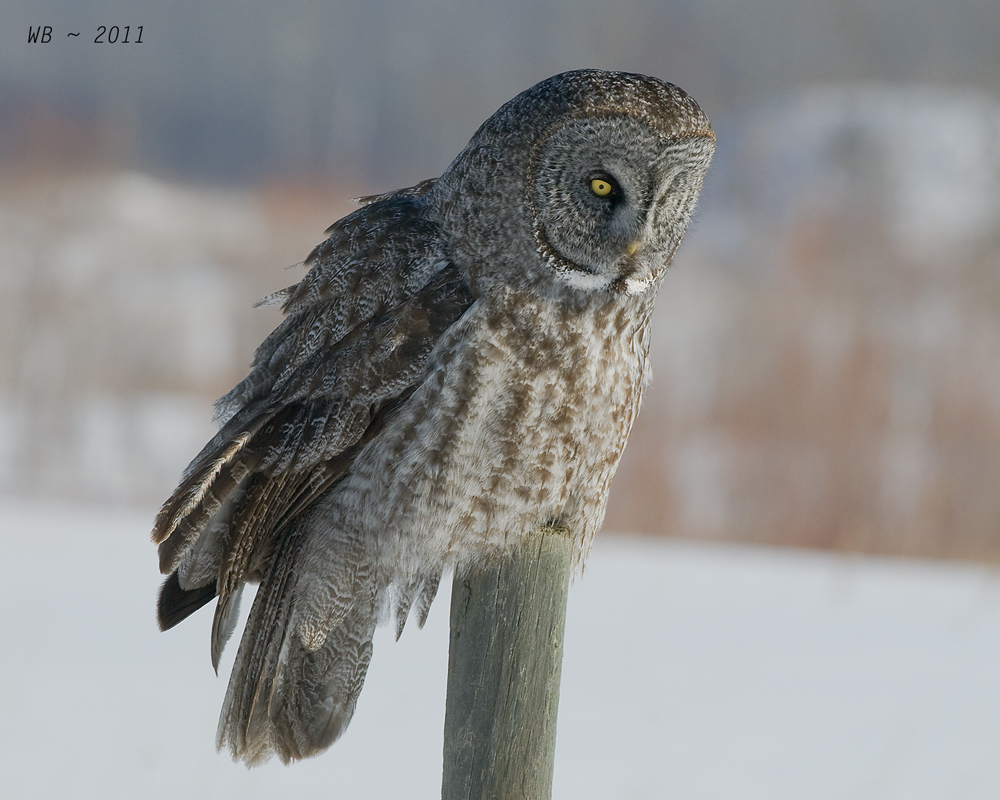


When their ears pick up the rustle of a vole or mouse beneath the snow, these owls don't just pounce, they plunge. With ice-pick talons tucked under their chins, Great Grays hurtle head-first into deep snow to snatch voles—diving with such power that they can shatter snow crust thick enough to hold a 180-pound person. They locate hidden prey with the help of large facial disks that funnel sound to their ears. When the plunge succeeds, the hunter wriggles out of the snow then carries the prey to a safe spot for consuming. 


The following photos are of a close encounter with Great Gray. When I spotted a pair of GGs on a range road in the Halfmoon Lake Natural Area, I stopped and got out of my vehicle with my binos. Almost immediately an owl approached and landed on a tree about 10ft above my car. I returned to the vehicle to retrieve my photo gear and proceeded to mount my lens on a tripod. When I reached into my pocket to retrieve a glove I pulled out my car keys inadvertently. They fell to the ground on the road and, in a flash of a feathery blur, GG pounced on them and lifted off with them in its talons. Oh my, I thought. Here I am on a lonely, little travelled country road, without a phone and GG has my only keys! It flew about 100ft into the forest, landed, inspected the keys, then promptly dropped them into the snow. Inedible, it must have thought. I waded through hip-deep snow, dug out my keys, and returned to my tripod. A minute later GG flew out of the forest and landed on a fence post about 50ft away, looking at me expectantly. By now I was a bit puzzled. GGs are relatively approachable, but this one is acting too oddly towards humans, I thought. It must have been fed or baited by humans before and had learned to associate people with handouts, I thought to myself. Then I noticed that it had a swath of primary wing feathers missing on its right wing. This did not affect its ability to fly (or to hunt, as I observed later), but it may be that it had been injured, nursed back to health in a wildlife hospice, then released once it could look after itself again. All the same, it looked to humans for food, as I would find out in a minute. I trained my lens on GG sitting on a post. Through my viewfinder, I saw it duck down into launch pose. Still through my viewfinder I saw it launch toward me, rapidly blurring out of focus. A split second later I felt one of its talons close on the middle finger of my right hand, my camera shutter hand. Startled, I looked up and saw GG sitting on a tree behind me. Evidently it must have seen the slight wiggle of my shutter finger and assumed that I had food in my hand. Its whack drew blood but was really quite gentle, more in the way of assertively begging for food than attacking a potential predator too close for comfort or too close to its nest.

[UPDATE: I have now found out a bit more about this owl. According to Gerald Romanchuk, among Alberta's premier birders and photographers, this owl was captured by his friend, Ray Cromie, an owl bander, a few weeks ago. Acccording to Ray, this same owl was banded by him 7 years ago, when it was aged as an after third-year bird and sexed as female. That makes this GG lady about 10 yrs old, quite remarkable, since, according to the textbooks, the average age in the wild for the GG is about 7 years. The missing wing primaries and some inner primaries, Ray and Gerald guess, is the result of an attack by a Great Horned Owl or a goshawk. As a way of helping the old lady out now and then, she has been given a mouse now and then, which explains her begging behaviour around humans. Thanks to Gerald Romanchuk for this information!]


After about 20 minutes of shadowing me from post to tree, this GG concluded I was not a sugar daddy. It flew off some distance and began to hunt. I saw it plunge into the snow about 6 or 7 times, but not with success. But I also saw the other Great Grays hunting, more often than not emerging from the snow without a catch. Of course, a vole is small, and GG's legs heavily feathered, so I may not have seen the catch even with my binoculars.

A few more of this magnificent hunter!


Oh yes, while entertaining myself with the owl (and, for a while, it with me) a moose ambled by, showing only glancing and mild interest.


Monday, February 28, 2011

"Shortie"


The Short-eared Owl (Asio flammeus) is a world traveler!  It can be spotted in every continent except Australia and Antarctica. Indeed, it is one of the most widely distributed owls on the planet.  It breeds in every province and territory in Canada.  


A medium-sized owl, about the size of a crow, this species likes vast stretches of fairly open habitat, particularly marshland and deep grass fields.  Prairies, grassy plains and tundra are some of its preferred summer haunts.  Large-scale destruction of native prairie grasslands, wetland drainage, urban expansion and increasingly intensive agricultural practices are contributing to the decline of the Short-eared Owl. It is on the “blue list” (species at risk) in Alberta and British Columbia.


I spent a most delightful few hours with this female “shortie” in Boundary Bay in south Delta, BC. Much of the bay is surrounded by marshland and grass fields and it’s proximate to the Fraser River delta, which is Shortie’s prime wintering area in BC.


The scientific name is from the Latin words asio, used by Pliny to specify a horned owl, and flammeus, meaning flaming or fiery and refers to the appearance of the bird’s plumage. The common name indicates the short feather tufts on its head that are difficult to see except when the owl is excited. This bird has also been called a Bog Owl, Flat-faced Owl, Grass Owl, and Marsh Owl.


Short-eared Owls actively hunt during the day (diurnal), at night (nocturnal), and at dusk and dawn (crepuscular). By using a low slow flight over the ground, they hunt small mammals such as voles (by far its preferred diet), moles and occasionally other birds.


The owls fly close to the ground and are noted for their erratic, bounding, hovering flight reminiscent of a butterfly. A hovering bird that sees prey dives toward the ground and carries its catch away in its talons. Short-eared owls often hunt while standing on the ground as well, or perching on a fence post in a characteristically horizontal position (unlike other owls that sit very upright). 


The Shortie in these photographs is a female. The male is a bit smaller and paler on the chest, with less streaking, and paler in its facial disk.


Sunday, February 20, 2011

Steel cold and blue

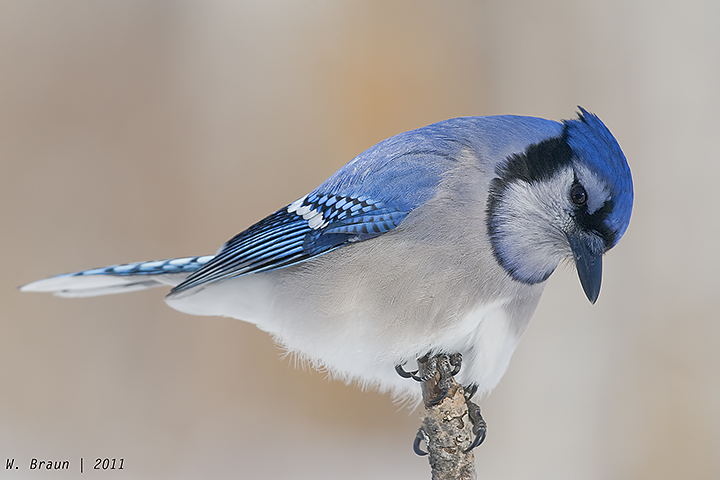
An usually cold late February day, - 28C when I left the house with camera, binoculars and coffee. The aim was to meander the range roads of Strathcona County, checking to see if the Hawk Owl was still around (it was) and looking for the Snowie Owls that have been seen there (none found). I did see a Goshawk, and the other usuals, Magpies, Chickadees, Ravens, Snow Buntings, and a few Redpolls. When I stopped in a layabout near an aspen stand I was almost immediately approached by 4 Bluejays. Although quite approachable in the city, they tend to be shy in the country. But these guys were both curious and evidently hungry and must have had some memory of humans as sugar daddies. Fortunately I had a handful of peanuts in my pocket and fed them to the jays one by one, enjoying their noisy fight over each peanut I threw at them. In return they sat around for a while, puffed up against the cold.

The Blue Jay, which occurs from southern Canada south to Texas and Florida, breeds in the mixed-wood forests of central Alberta, Saskatchewan, and southern Manitoba, and from there east through central and southern Ontario to southern Quebec, Newfoundland, New Brunswick, Prince Edward Island, and Nova Scotia. It is rarely found on the western side of the Rocky Mountains.


The Blue Jay’s scientific name (Cyanocitta cristata) is derived from Greek and Latin words and means, "crested, blue chattering bird," an apt designation. The Blue Jay belongs to the crow family, or Corvidae, a group of 100 related species including ravens, rooks, jackdaws, crows, magpies, and jays. Some of these species are the largest members of the order Passeriformes, or perching songbirds. These birds are ancient in evolutionary terms; fossil remains of corvids have been identified from Miocene deposits 25 million years old. Perhaps no wonder that Corvids are the most intelligent birds.


This Jay is a truly noisy creature; cries to warn other birds and mammals of an approaching predator, to announce a find of food, and often, for no apparent reason. The 19th-century writer Henry David Thoreau described the Blue Jay’s most characteristic sound as an "unrelenting steel-cold scream,” that is particularly grating on a steel-cold day. Actually, they do have a wide variety of other calls, particularly a mellow whistle, kloo-loo-loo, quite musical in form, and also a softly delivered courtship song, a continuous sweet warbling heard in spring.


The most attractive visual feature of the Blue Jay is its vivid cobalt or azure-blue tail and wing feathers that make an exotic contrast against brown leaves or green grass or white snow. However, these feathers are not truly blue. Blue pigment is unknown in birds. The Blue Jay’s feather colour results from refraction, or distortion, of light by a peculiar inner structure of the feather substance. If the feather is crushed, the blue colour disappears. A cool fact!


On the way home a coyote, hunting for rodents in the stubble fields, warily stopped to give me a dirty look!